Soho House Room Booking, Redesigned
UX Strategy
MVP
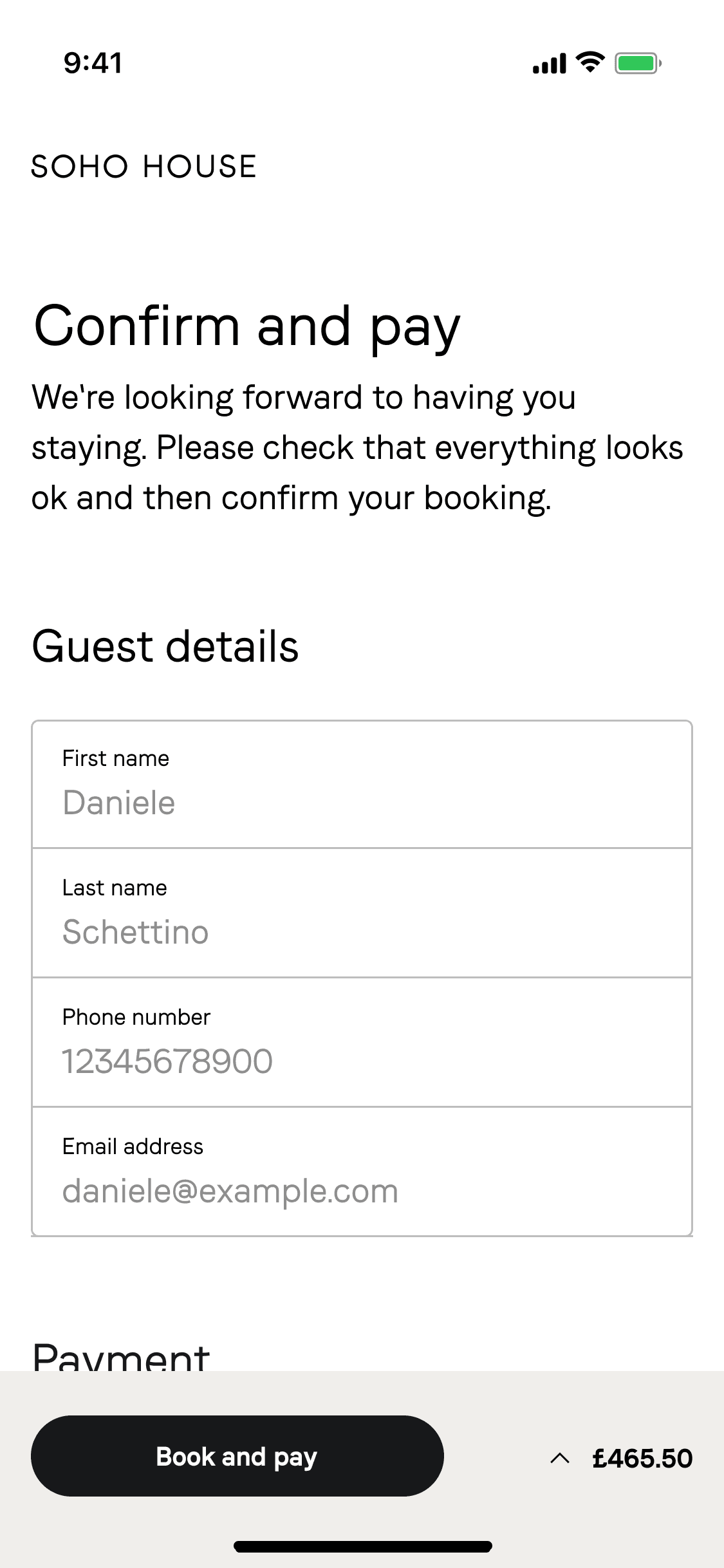
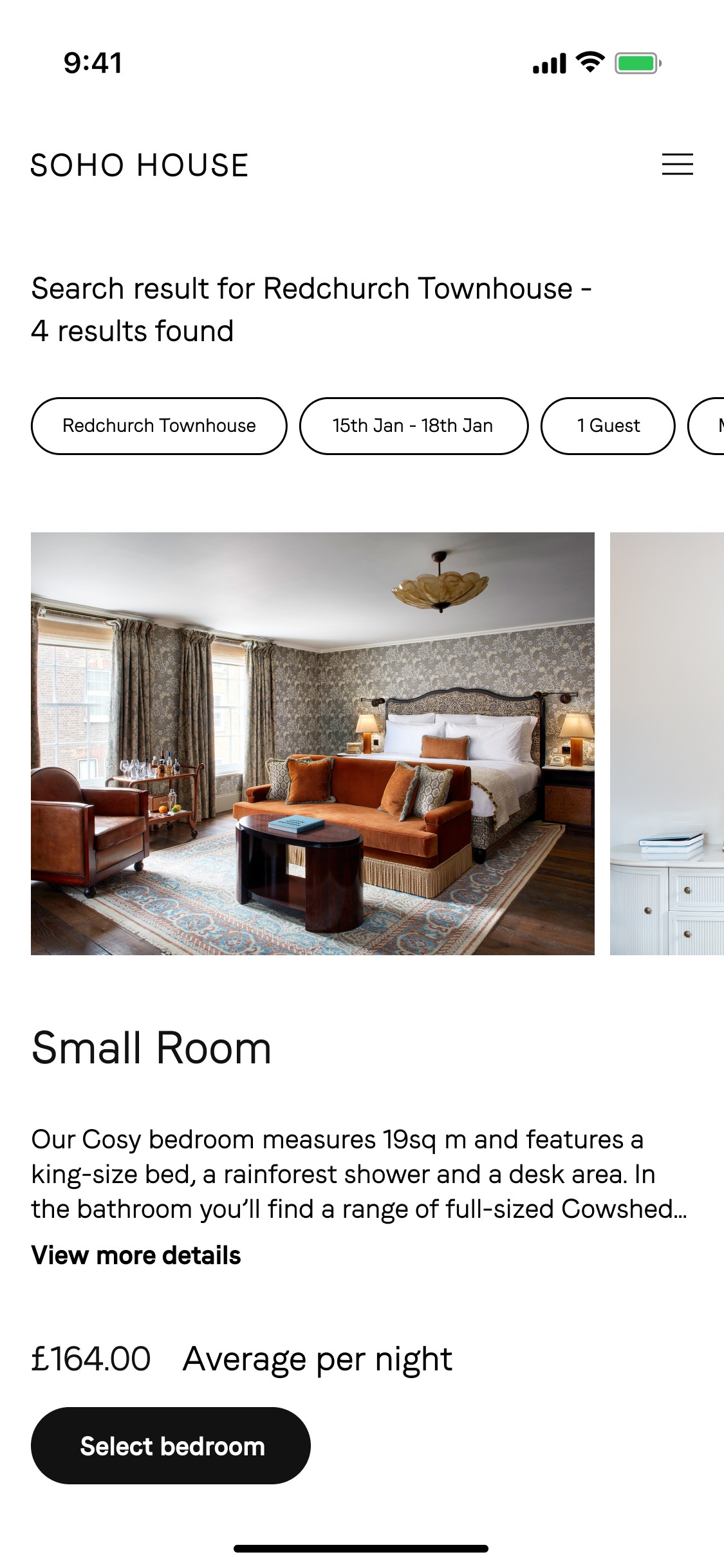
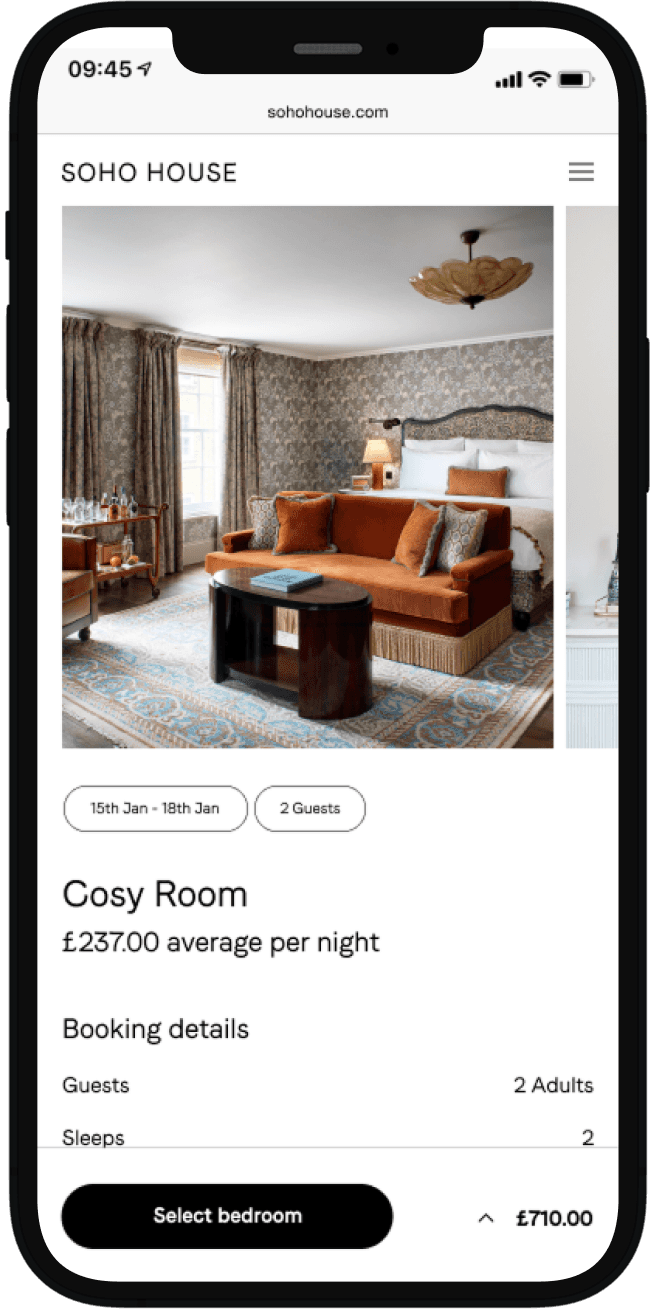
A simplified booking journey that reduces drop-off by making availability, pricing, and payment steps clear from start to finish, for Soho House members.

Outcome &
Impact

Adoption
+75%
increase in bookings following the launch of the redesigned experience
Channel share
90%
Web became the primary booking channel within a year of launch.
Operational efficiency
Reduced manual booking requests from House teams.
Outcome &
Impact
Adoption
+75%
increase in bookings following the launch of the redesigned experience
Channel share
90%
Web became the primary booking channel within a year of launch.
Operational efficiency
Reduced manual booking requests from House teams.
Business impact


Before
Pricing unclear until checkout
Inconsistent booking rules across Houses
Fragmented journey across desktop and mobile
After
Transparent pricing throughout booking
Clear payment expectations before checkout
Consistent experience across desktop and mobile
The challenge
The Soho House room booking experience ran on a third-party hotel platform that felt confusing and lacked key details, especially around total price and payment expectations. It was costly to maintain and didn't reflect the premium Soho House standard. We had 12 weeks to redesign the flow end-to-end: bring price transparency forward, clarify payment timing, standardise policies across Houses, and strengthen review and confirmation states to reduce abandonment.
My role
I was the primary designer on the room booking initiative, owning the experience end-to-end and partnering closely with Product, Engineering, and Insights. My focus extended beyond execution to problem framing, cross-functional alignment, and guiding design decisions under constraints.
Research focused on understanding why members abandoned bookings and what information they needed to complete a reservation with confidence.
Research approach
Member
interviews
Quantitative
booking data
Workshop &
Persona
User
testing
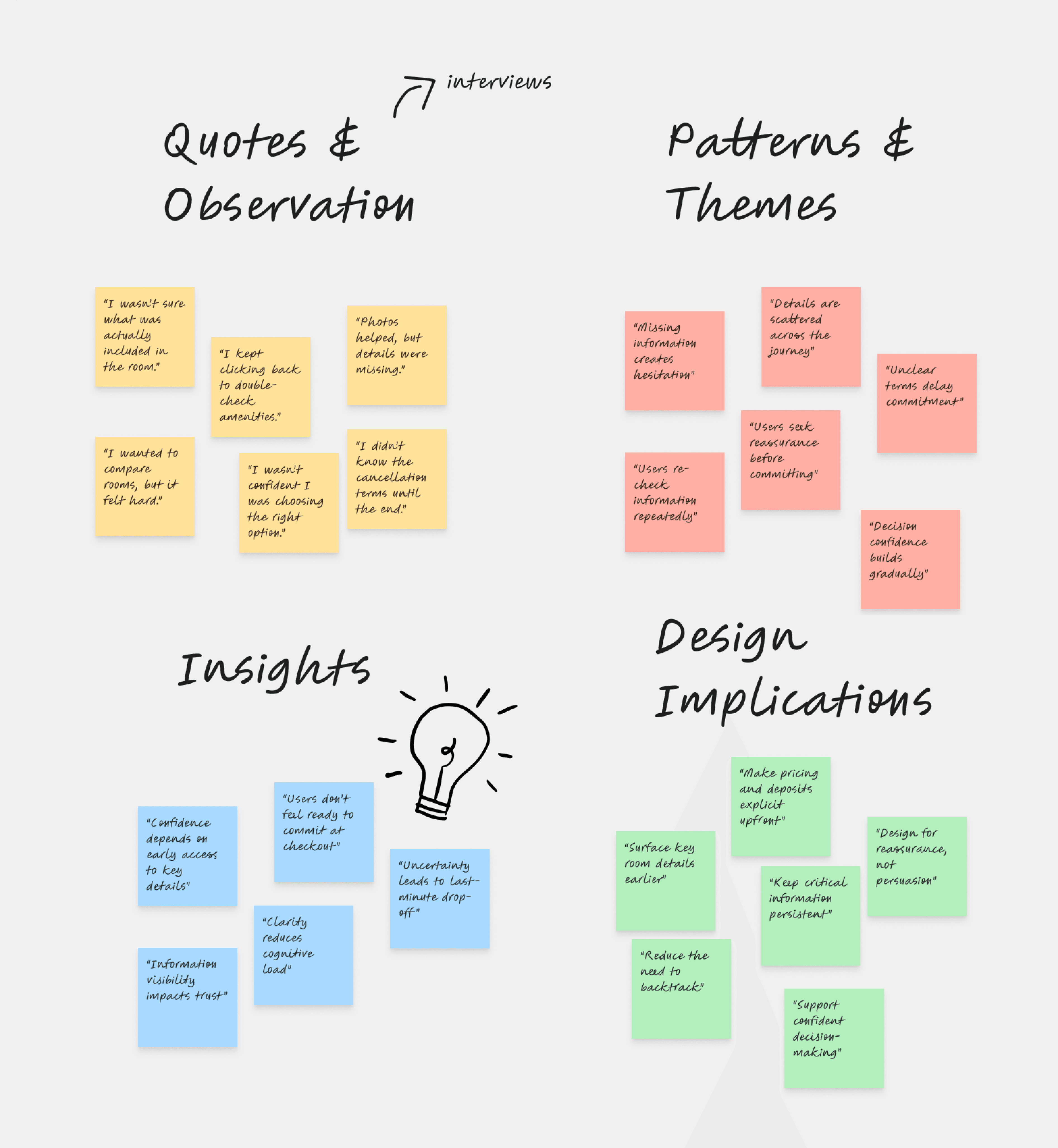
User interview insights
Pricing uncertainty causes abandonment
Information builds confidence
Design principles
Outcome: These insights directly informed experience principles and flow restructuring.
These principles aligned the team and reduced subjective debate during design reviews.
Principle #1
Clarity before commitment
Surface key room pricing, and booking details early to build trust and confidence before members commit to a reservation.
Used to guide
Room detail hierarchy - Pricing and deposit disclosure - Checkout sequencing
Principle #2
Minimise effort, not information
Reduce steps and friction without hiding complexity or removing user control, allowing members to make informed decisions quickly.
Used to guide
Interaction patterns and overlays - Progressive disclosure - Inline editing within the flow
Principle #3
Consistent across devices
Preserve flow and mental models across desktop and mobile by adapting interactions without fragmenting the journey.
Used to guide
Overlay vs full page transitions - Responsive behaviour - Cross device parity
Solution & design decisions
My approach focused on cognitive load reduction, trust signaling, and modular task grouping.
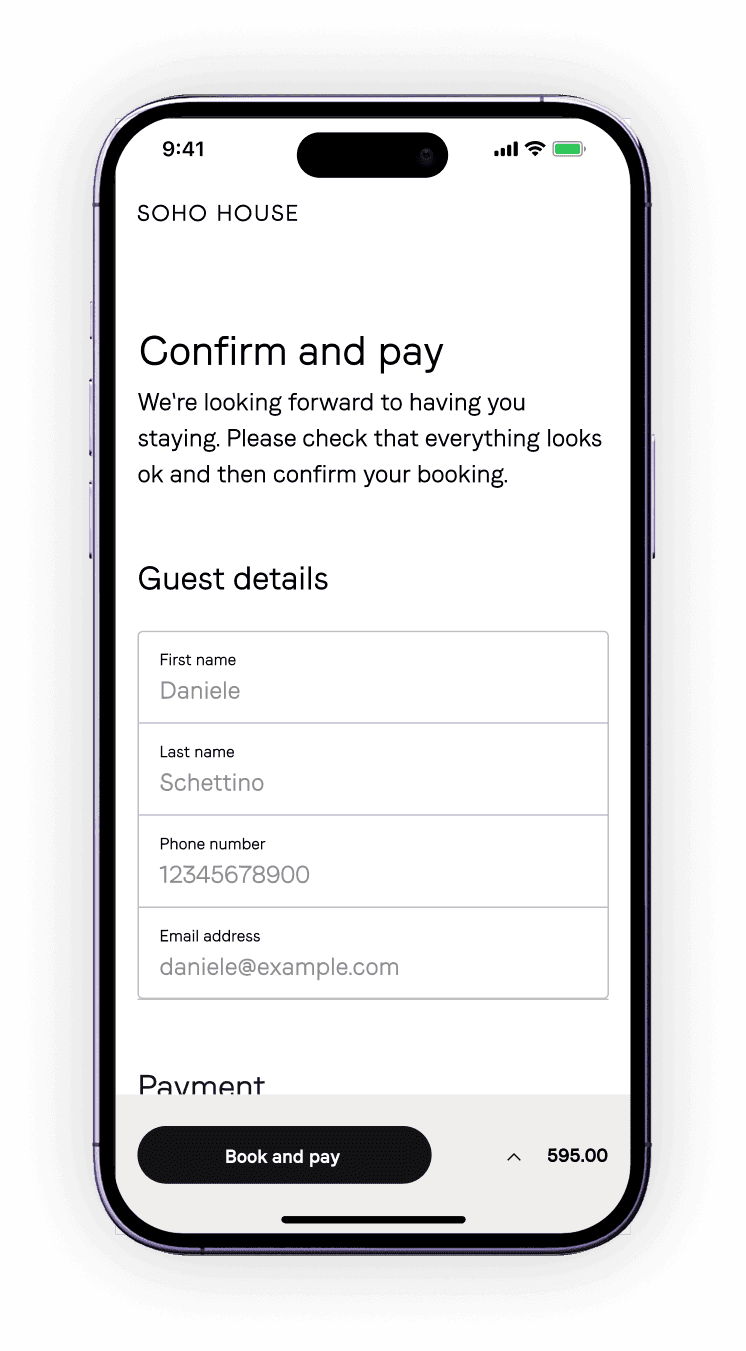
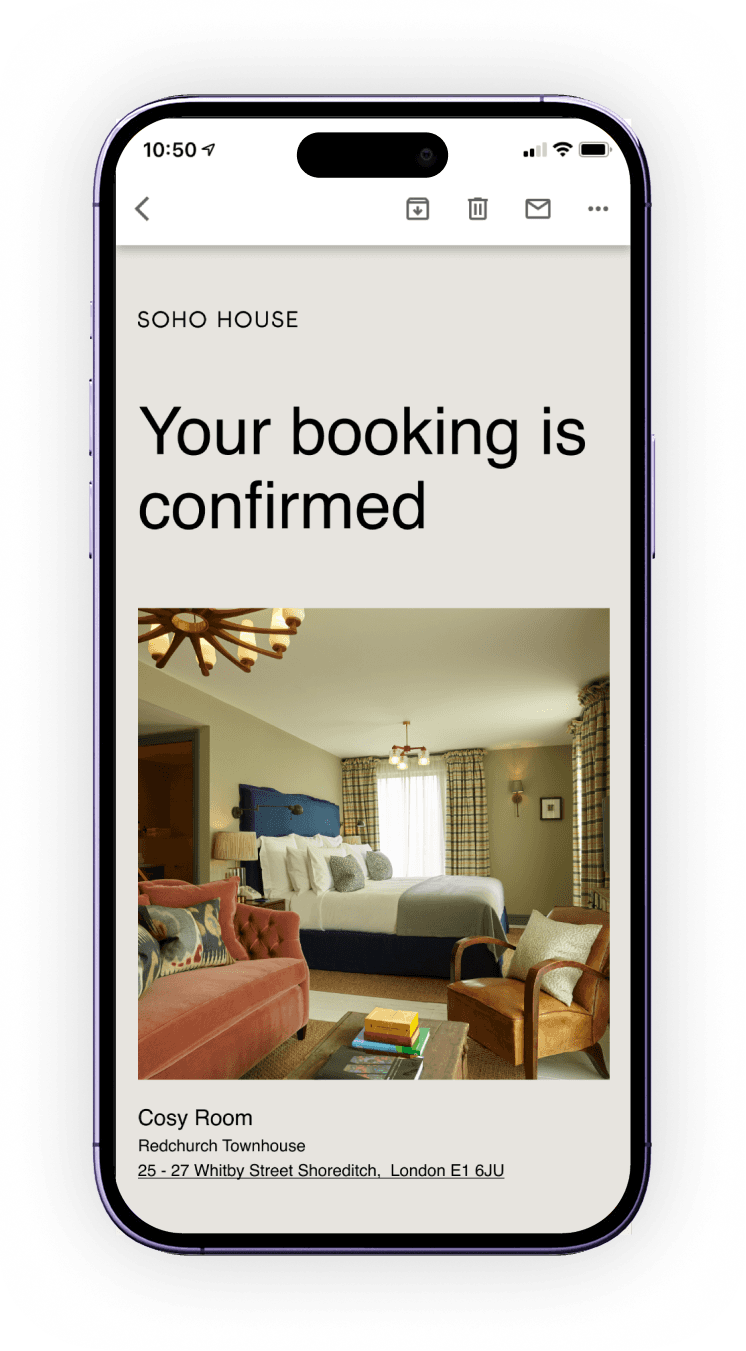
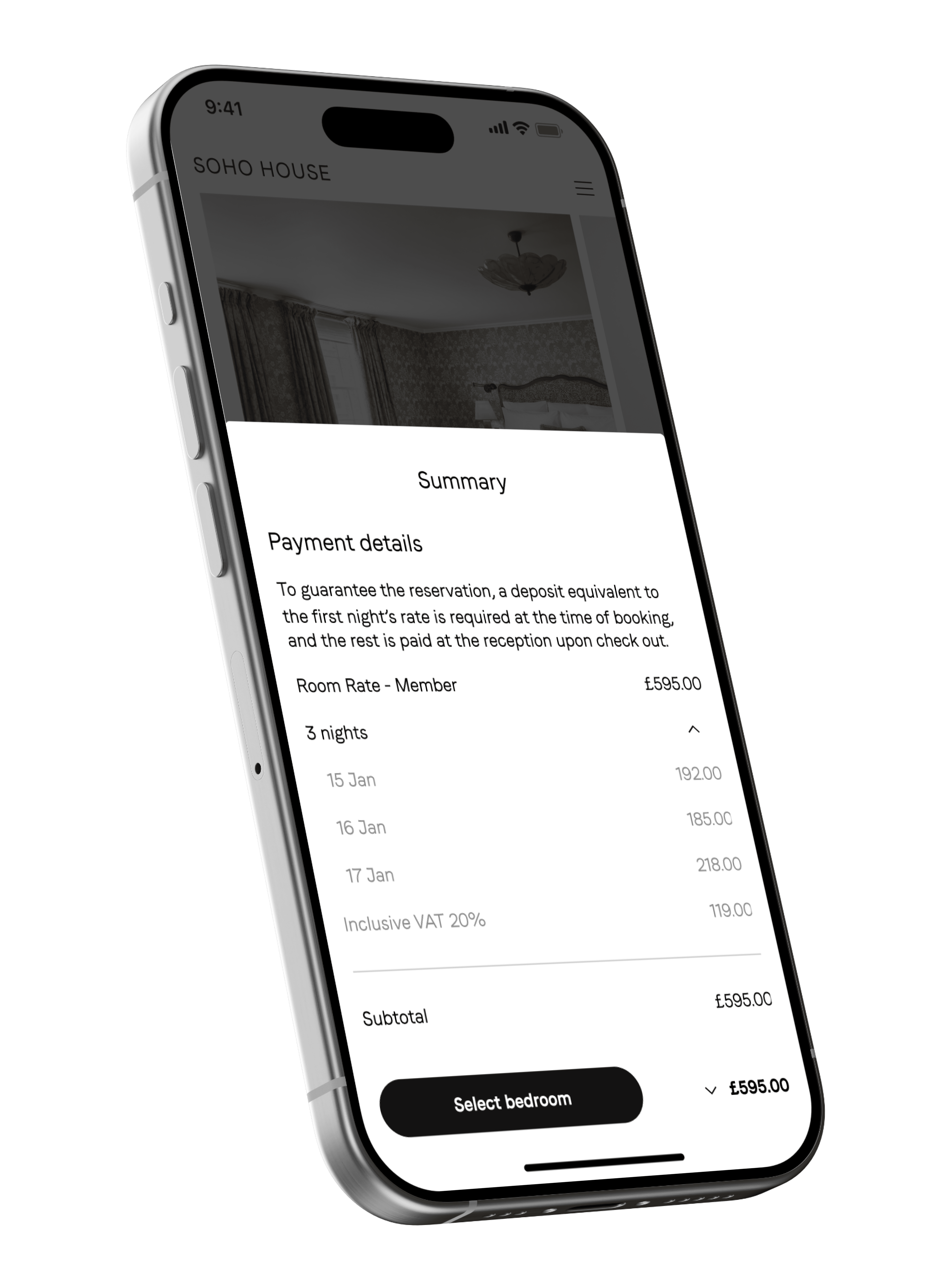
Design decisions
Decision
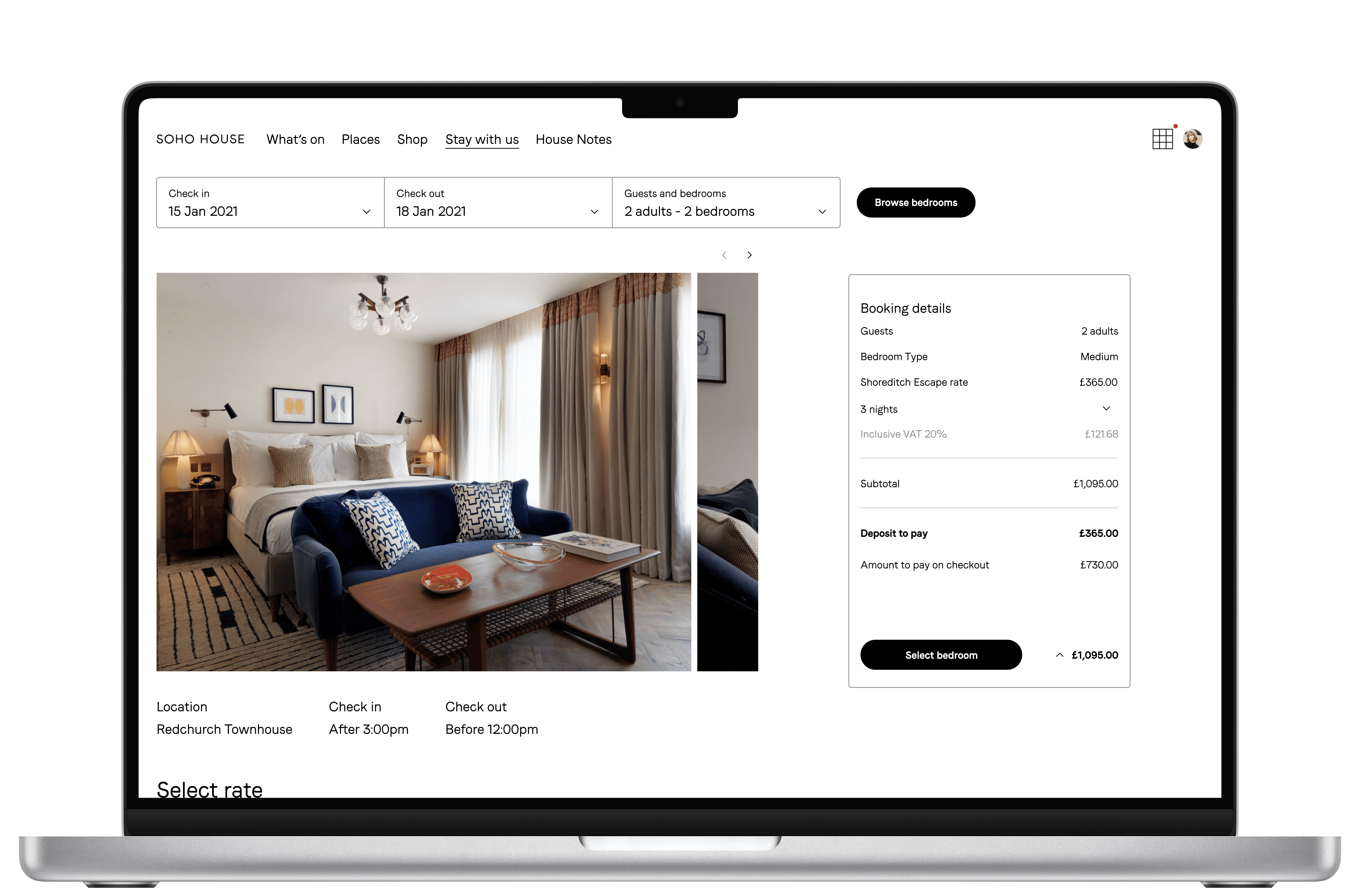
Surface key room information earlier in the booking journey and keep it visible as users progress.
Impact
Reducing uncertainty earlier increased confidence and improved booking completion.
Decision
Make pricing, deposits, and payment timing explicit before checkout with a clear breakdown visible throughout the flow.
Impact
Setting expectations earlier reduced last-minute abandonment and support requests.
Decision
Let users change details in place using quick pop-ups and inline edits so they don’t have to leave the booking flow.
Impact
Preserving momentum reduced cognitive load and made the checkout experience faster and more forgiving.
User test results
90%
Satisfied response
12
Participants
Worldwide
Explore other projects
Project agenda
Problem statement
The room booking experience relied on a third-party hotel platform that felt confusing and lacked key details, especially around total price and payment expectations. It was also costly to maintain and didn’t reflect the premium Soho House experience.
Pipeline
Map where confidence drops, simplify the end-to-end flow, then validate the new structure through quick prototypes and usability testing.
Timeline
12 weeks to complete the project, including research, design, and testing.
Delivery plan
Bring price transparency earlier (total + fees), clarify payment timing, standardise policies/availability across Houses, and strengthen review + confirmation states to reduce abandonment.
Before
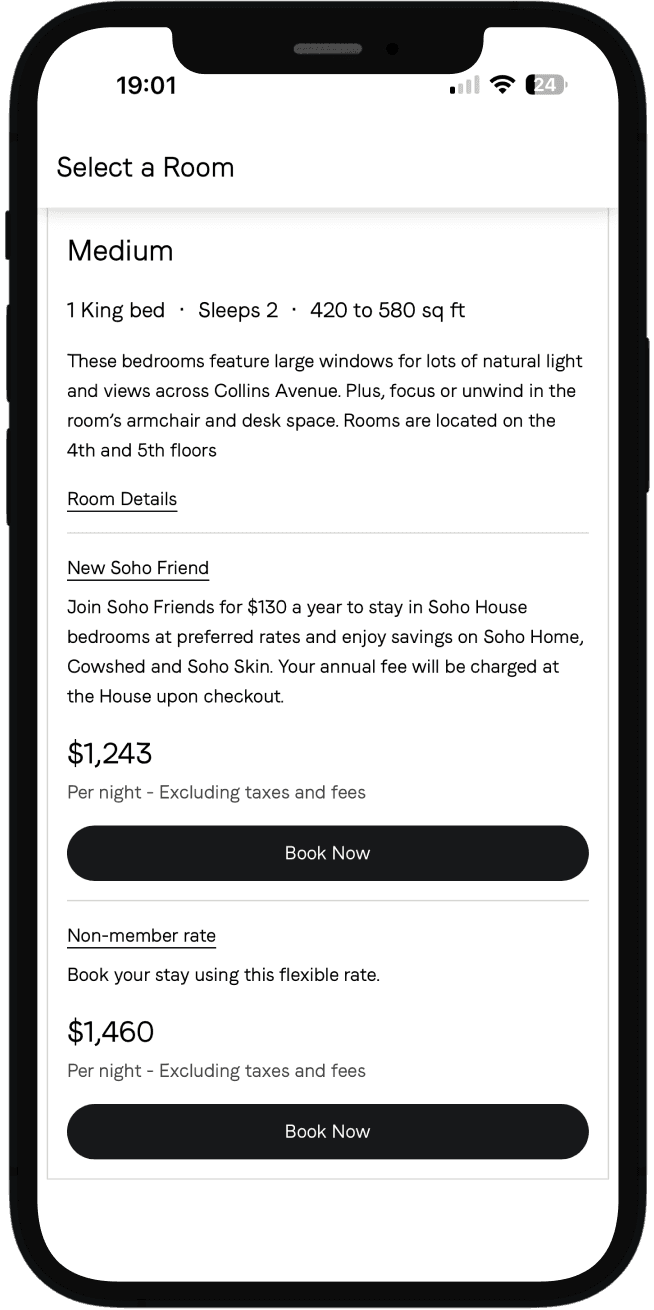
Pricing unclear until checkout
Inconsistent booking rules
Members unsure about payment expectations
After
Transparent pricing throughout booking
Clear payment expectations before checkout
Consistent booking interaction patterns
Establish scalable booking interaction across devices
Business impact
The challenge
The Soho House room booking experience ran on a third-party hotel platform that felt confusing and lacked key details, especially around total price and payment expectations. It was costly to maintain and didn't reflect the premium Soho House standard. We had 12 weeks to redesign the flow end-to-end: bring price transparency forward, clarify payment timing, standardise policies across Houses, and strengthen review and confirmation states to reduce abandonment.
My role
I acted as the design lead for the dotcom room booking initiative, owning the experience end to end while partnering closely with Product, Engineering, and insights. My focus extended beyond execution to problem framing, alignment, and guiding decision-making under constraints.
Research approach
Member interviews
User testing
Quantitative booking data
Workshop & Persona
Research focused on understanding why members abandoned bookings and what information they needed to confidently complete a reservation.
User interview insights
Insight #1
Pricing uncertainty causes abandonment
Insight #1
Pricing uncertainty causes abandonment
Insight #2
Information builds confidence
Insight #2
Information builds confidence
Design principles
Outcome: These insights directly informed experience principles and flow restructuring.
These principles aligned the team and reduced subjective debate during design reviews.
Principle #1
Clarity before commitment
Surface key room pricing, and booking details early to build trust and confidence before members commit to a reservation.
Used to guide
Room detail hierarchy - Pricing and deposit disclosure - Checkout sequencing
Principle #2
Minimise effort, not information
Reduce steps and friction without hiding complexity or removing user control, allowing members to make informed decisions quickly.
Used to guide
Interaction patterns and overlays - Progressive disclosure - Inline editing within the flow
Principle #3
Consistent across devices
Preserve flow and mental models across desktop and mobile by adapting interactions without fragmenting the journey.
Used to guide
Overlay vs full page transitions - Responsive behaviour - Cross device parity
Solution & design decisions
My approach focused on cognitive load reduction, trust signaling, and modular task grouping.
Design decisions
Decision
Surface key room information earlier in the booking journey and keep it visible as users progress.
Impact
Reducing uncertainty earlier increased confidence and improved booking completion.
Decision
Make pricing, deposits, and payment timing explicit before checkout with a clear breakdown visible throughout the flow.
Impact
Setting expectations earlier reduced last-minute abandonment and support requests.
Decision
Let users change details in place using quick pop-ups and inline edits so they don’t have to leave the booking flow.
Impact
Preserving momentum reduced cognitive load and made the checkout experience faster and more forgiving.
User test results
90%
Satisfied response
12
Participants
Worldwide
Outcome & Impact
Adoption
+75%
increase in bookings following the launch of the redesigned experience
Channel share
90%
Web became the primary booking channel within a year of launch.
Operational efficiency
Fewer manual requests for House teams, improving operational efficiency
Outcome & Impact
Adoption
+75%
increase in bookings following the launch of the redesigned experience
Channel share
90%
Web became the primary booking channel within a year of launch.
Operational efficiency
Fewer manual requests for House teams, improving operational efficiency
Soho House Room Booking, Redesigned
UX Strategy
MVP
A simplified booking journey that reduces drop-off by making availability, pricing, and payment steps clear from start to finish, for Soho House members.