
My role
Sole designer on Kaching, embedded with Product and Engineering. I owned research, information architecture, and design end-to-end: from a card sort with six crypto newcomers that shaped the product IA, to two rounds of usability testing that determined when and how Megadraw launched.
The research question
1,500+
SURVEY RESPONSES - FIRST TIME DEFI STRUGGLE
They couldn't decide which protocol to put their assets in
They found crypto jargon intimidating before they'd even tried anything
They were reluctant to stake because locking assets felt too permanent
They overestimated the risk involved in getting started with DeFi
Claude research
To go deeper on the dormant token piece specifically, I used Claude to pull together published research and existing articles on why users hold idle crypto. The external literature lined up with what the survey was showing.
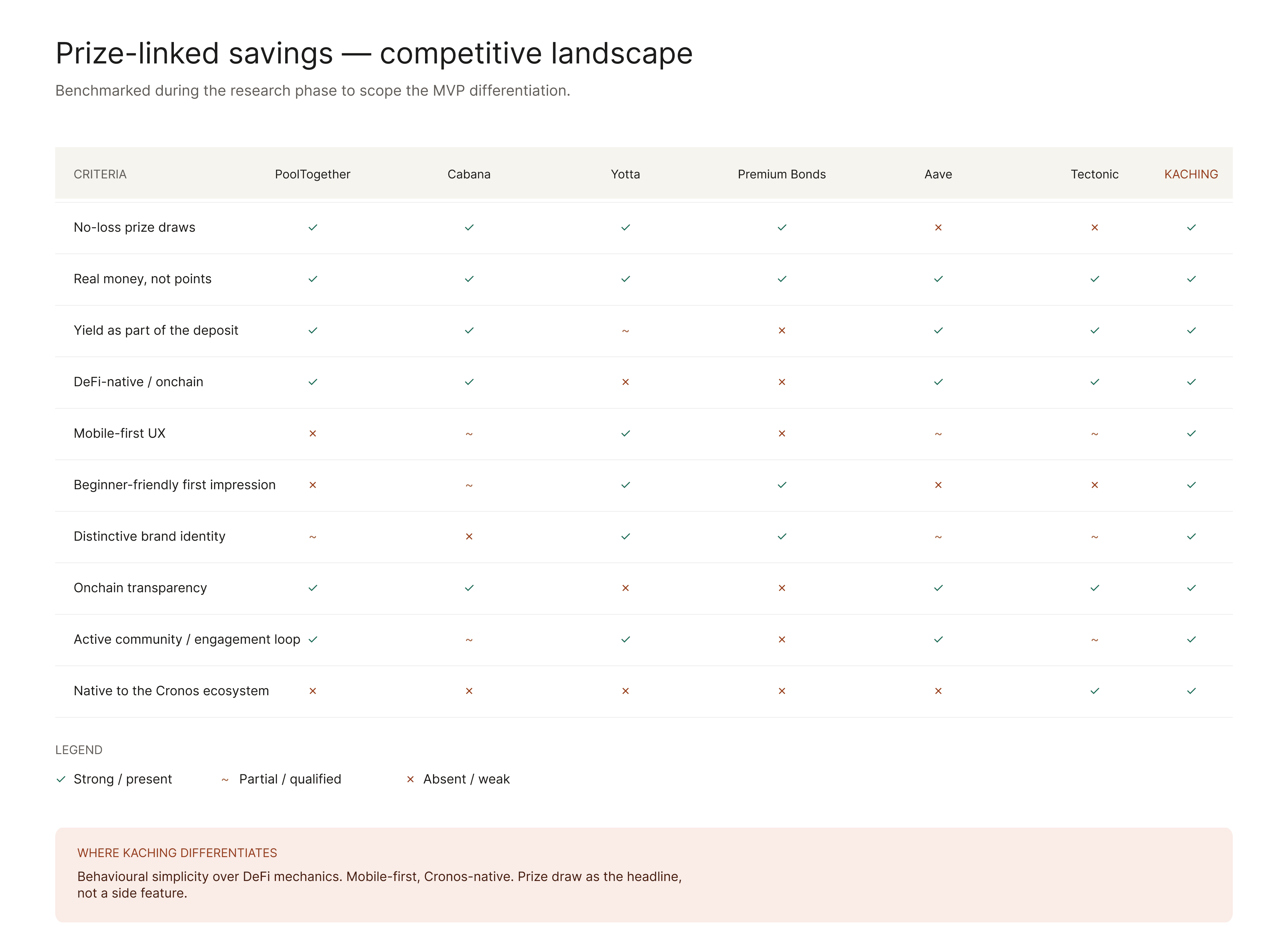
I audited six prize-linked staking and DeFi yield products: PoolTogether, Cabana, Aave, Tectonic, Yotta, and Premium Bonds comparing feature set, visual approach, and real usage data.
Where Kaching differentiates
Behavioural simplicity over DeFi mechanics.
Mobile-first, Cronos-native
Prize draw as the headline, not a side feature
Using the user's
language
Hypotheses
Words like "staking" and "yield" signalled "this isn't for me" before they'd see a single screen. Remove that language barrier and they might stay long enough to see the value.
Hypotheses
Users couldn't decide which protocol to trust, so they did nothing. A prize draw needs no evaluation. Lead with that and they might engage.
Hypotheses
Users assumed that if anything went wrong, their deposit was gone. That fear kept tokens sitting idle. If they understood upfront that their money is never at risk, that barrier disappears entirely.
Together these lead cleanly to the reframe: if all three are true, then positioning this as
a savings account with a prize on top is the logical call.
DEFI LANGUAGE
KACHING LANGUAGE
Staking pool
Savings account
Yield
Interest
DeFi protocol
Savings app
Liquidity
Your money
Card sorting workshop
Before touching Figma, I needed to lock the product structure. Account management, lottery, and Megadraw had distinct jobs but no obvious hierarchy.
I ran a card sorting workshop with 6 crypto newcomers (CRO holders who had never used a DeFi product) to understand how they naturally grouped the product's core concepts. The session produced a first draft IA that became the foundation for user testing.

The card sort produced four top-level surfaces.


Design principles
Principle #1
Plain language over jargon
The survey showed jargon was the first barrier. Users felt intimidated before they'd even opened a protocol. We used mental models they already had: savings accounts, Premium Bonds.
Principle #2
Make the prize the product
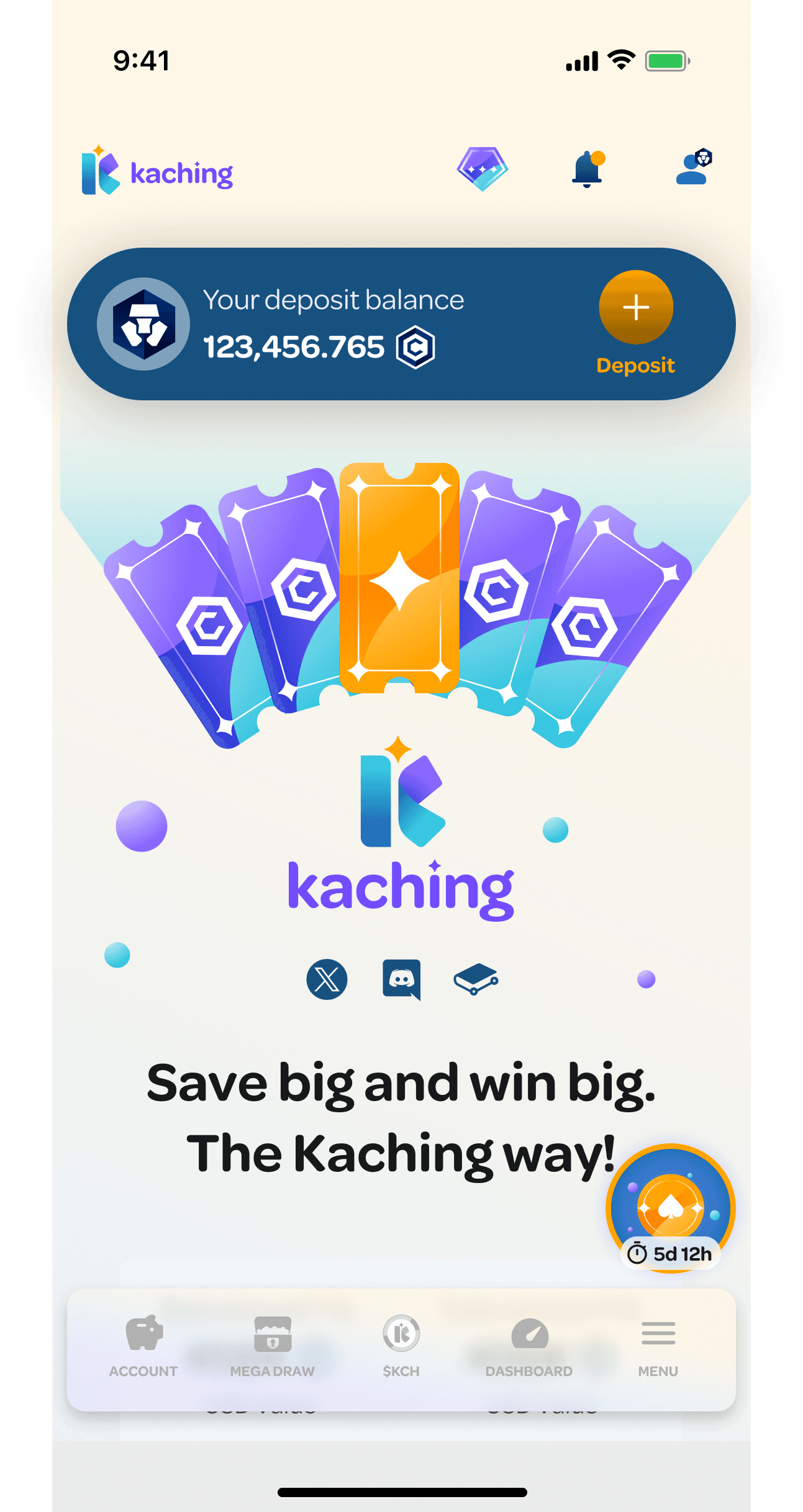
Every product in the competitive audit buried the draw as a secondary feature. Kaching makes it the headline. Every screen keeps the next draw visible.
Principle #3
Keep them coming back
Activating a dormant wallet once wasn't enough. A deposit is just the entry point. Gamification, competition, and the daily draw are what turn it into a habit.
Principle #4
Build trust first
Claude research showed users were already overestimating the risk before they'd touched the product. Clarity and transparency at every step has to come before the ask.
Wireframing & Validation
With the IA locked and principles defined, I moved into wireframing and early validation. The core deposit and lottery flow borrowed proven DeFi patterns, so the focus was on what we didn't yet know: whether users would understand the Megadraw mechanic. Eligibility tiers and prize-share math were new territory. The goal was to catch confusion before high fidelity.


User test results
8 participants: the core deposit and lottery experience, and the Megadraw.
All participants completed the deposit flow, understood that CRO deposited earned lottery tickets, and could navigate the draw experience without friction.
3 things didn't hold up.
The star rating for winning chances was ambiguous, nobody knew what it meant or how to improve it.
The account and dashboard were merged into one screen, creating too much density and no clear next action.
The Megadraw eligibility mechanic confused users; they needed more context before they'd trust it.

Post-testing design decisions

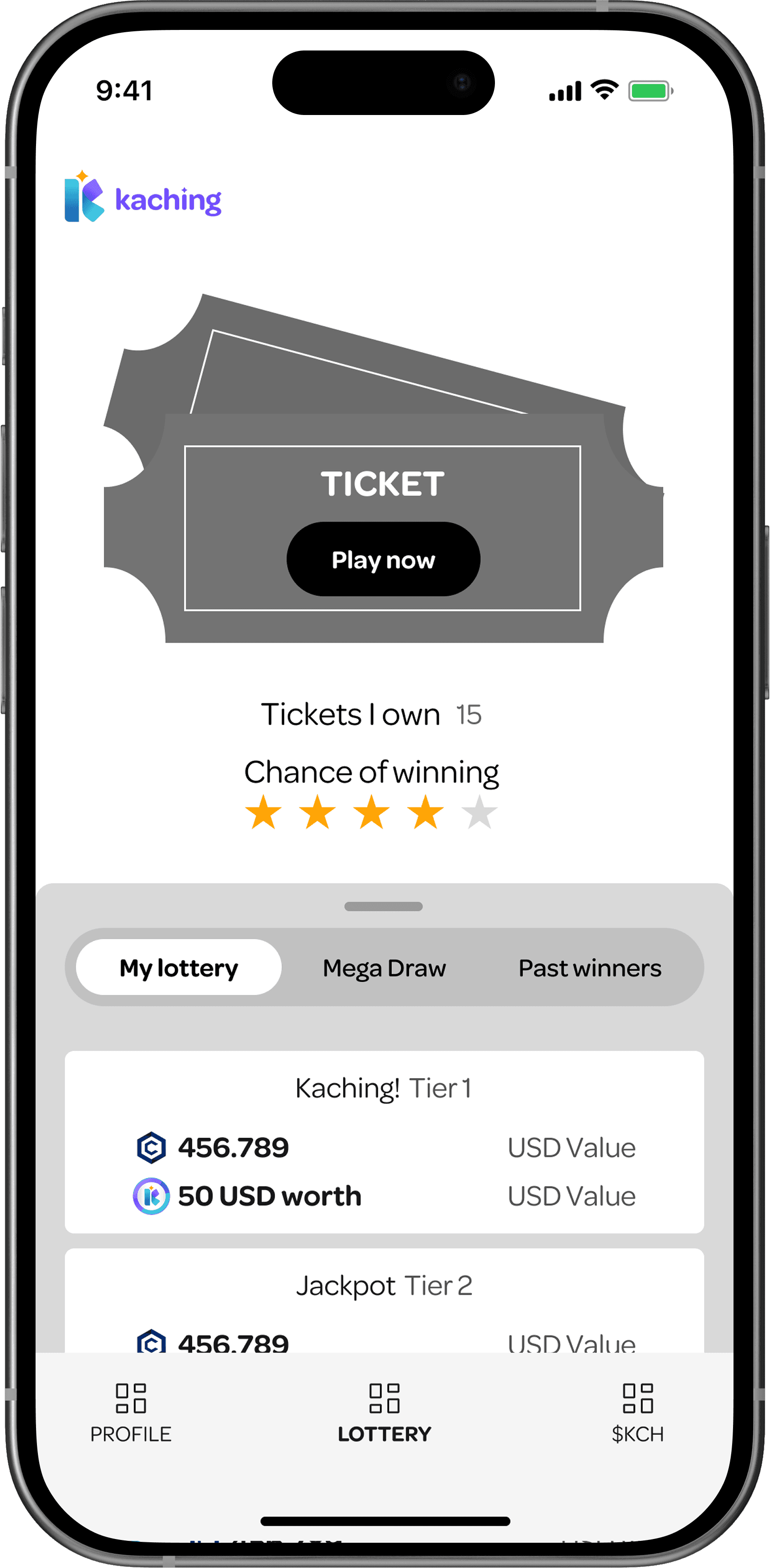
Winning chances
I confirmed with engineering that threshold data was queryable in real time, which unlocked a probability ladder tied to actual deposit amounts. The nudge ("Deposit 6,735.98 CRO to increase your chances to 50%") translates abstract probability into an actionable next step.

MVP screens
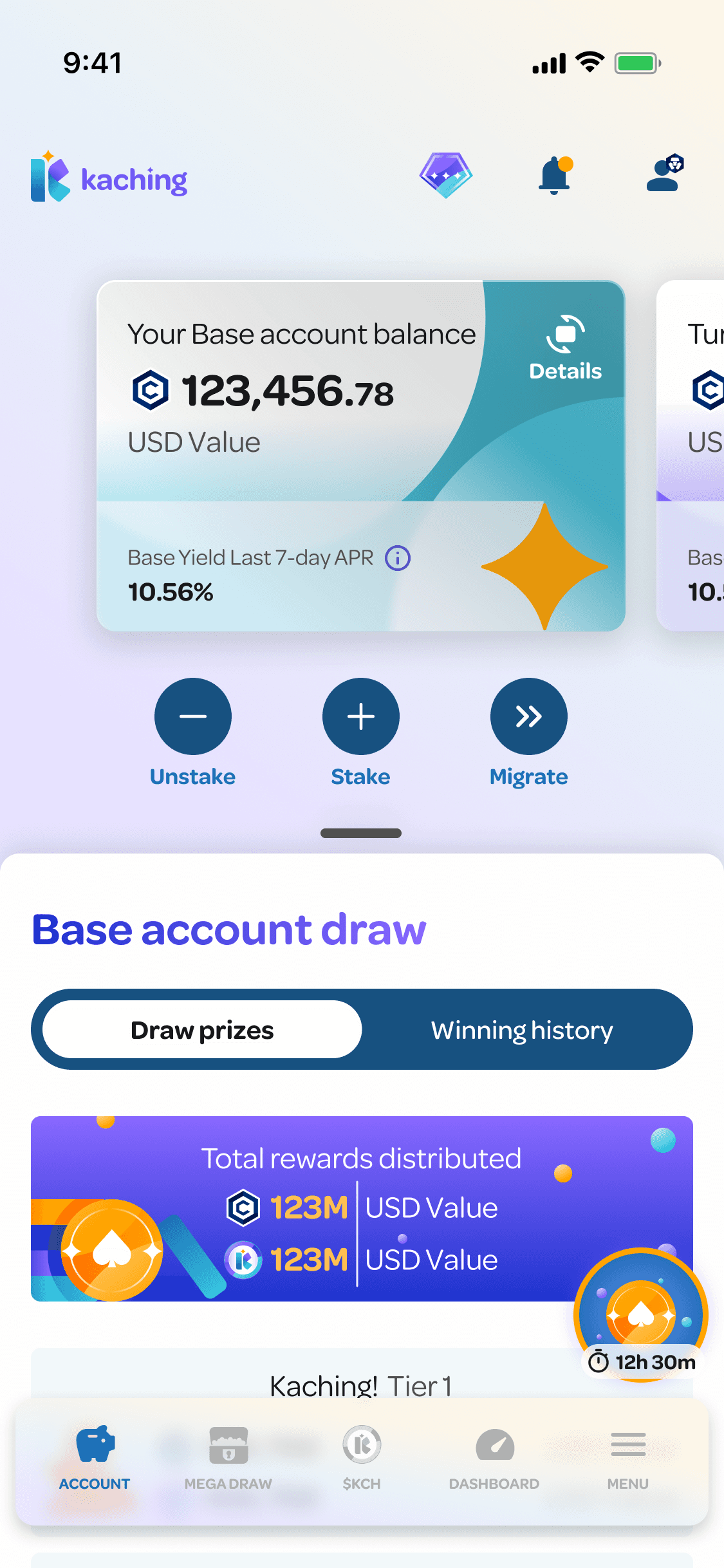


Megadraw iterations
Post MVP
First-round testing surfaced three gaps. I mapped them to design decisions before opening Figma.
Finding 1
The Megadraw mechanic was visible but the eligibility rules weren't. Users saw a prize they couldn't connect to their deposit.
Finding 2
There was no visible sense of personal impact. Users couldn't see how their deposit moved the milestone forward.
Finding 3
Megadraw and the daily draw felt identical. Without a clear distinction, the flagship was losing its identity.
Design decisions
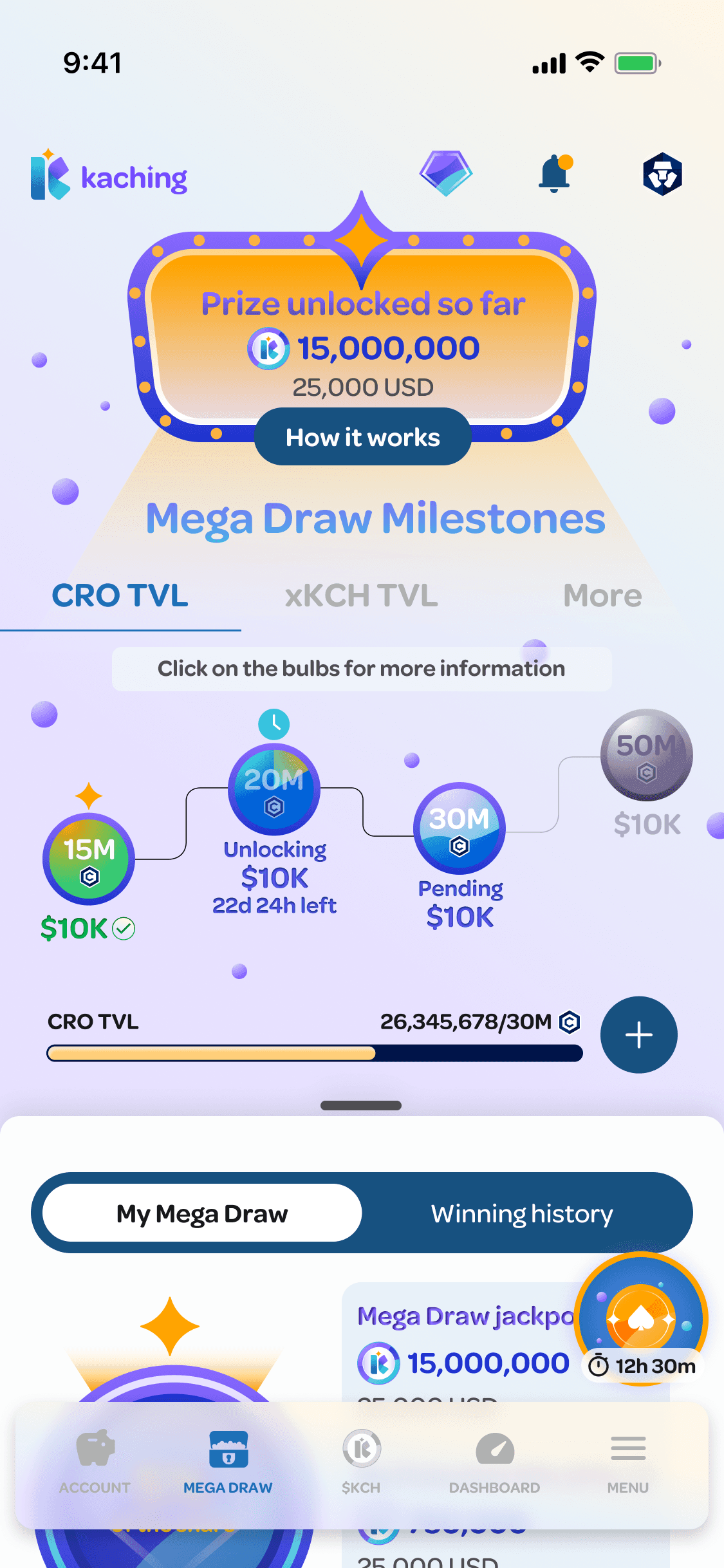


Megadraw second testing
Once the MVP launched I ran a second round of user testing, 70% of tasks focused on Megadraw, 30% revalidating the core flows.
10 out of 12 participants
One had difficulty navigating between milestone states; one needed the Gitbook to fully grasp eligibility, room to improve,
but a significantly stronger result than round one.
Megadraw launched one month after MVP.


20% → 14% → 9%
of idle CRO holders activated their tokens over 12 and 24 months, turning dormant balances into staked liquidity in the pool.
31%
weekly regular users
The weekly draw cadence gave one-time stakers a recurring reason to return. The rest stayed parked for interest
+27%
Growth in Cronos on-chain users
New stakers entering the pool grew the chain's genuine active user base by over a quarter.
Learnings
The biggest lesson was research sequencing. Megadraw's mechanics were new enough to need concept testing before the IA was locked, not prototype validation after. Earlier qualitative interviews would have caught how users thought about eligibility and unlocking periods at the right moment and probably would have surfaced the star rating problem sooner too.
The card sorting workshop was the right call and held all the way through to Megadraw launch. Front-loading structural alignment is always worth it.